How to Build an Innovation Portfolio From Scratch: A 4-Step Process for Mid-Market Manufacturers
A folder of ideas is not an innovation portfolio. Here is a four-step process a mid-market manufacturer can run internally in about three weeks to turn scattered ideas into a scored, board-ready shortlist of Anchor Moves.
July 6, 2026
You Have the Ideas. You Don't Have a Portfolio.
Picture the whiteboard from last year's planning offsite: thirty ideas that nobody referenced in February. Your team built a shared spreadsheet where every leader has opinions, and the initiative that got funded was the one argued with the most conviction, not the one that would have scored best. If that sequence is familiar, the problem is not that you lack ideas.
It never is. Robert G. Cooper has spent four decades studying why new-product investment decisions succeed or fail, across hundreds of companies. His research finds the same pattern every time it's measured: generating ideas is common. Effective portfolio management, the discipline of scoring and ranking them, is consistently one of the weakest facets of new-product development, even at companies that execute individual projects well [Cooper & Edgett, 2012]. The gap is not at idea creation. It is at what happens after the list is built: scoring, ranking, and giving the best idea enough armor to survive contact with the budget meeting.
That gap has a name, the portfolio gap, and there is a process to close it: one that a mid-market manufacturer can run internally in approximately three weeks.
An Idea List Is Not a Portfolio: Here Is the Difference
For any manufacturer who has run at least one planning cycle, the counterintuitive finding holds: you already have the ideas. They live as tribal knowledge: off-site whiteboards, engineering backlogs, years of customer conversations. What is missing is not the raw material. It is the scoring mechanism that makes the right opportunities defensible.
The structural difference is concrete. An idea list is a slide deck containing 30 bullet points with no score, no rank, and no documented rationale. When the executive leadership team asks why the third bullet matters more than the fifteenth, there is no answer except seniority. A portfolio is different in kind. Every opportunity has a score against explicit dimensions. Every opportunity has a rank by composite score. Every opportunity has a documented rationale that the champion can hand to the executive leadership team, with no consultant needed to translate it.
Our position is that manufacturers have less of this discipline than the general business population, not more. Scoring and ranking is administrative overhead, and mid-market manufacturers run leaner than most other industries: tighter margins, smaller corporate staffs, and less dedicated strategy function. The capability that generic businesses struggle to build is harder still to build on a plant floor.
The belief shift is this: a list is not a portfolio. A portfolio is scored, ranked, and defensible. That is what survives a budget cycle.
Is your idea inventory ready to enter that process?
Who This Process Is For and What You Actually Need to Start
The starting line is lower than you think. Three inputs are required:
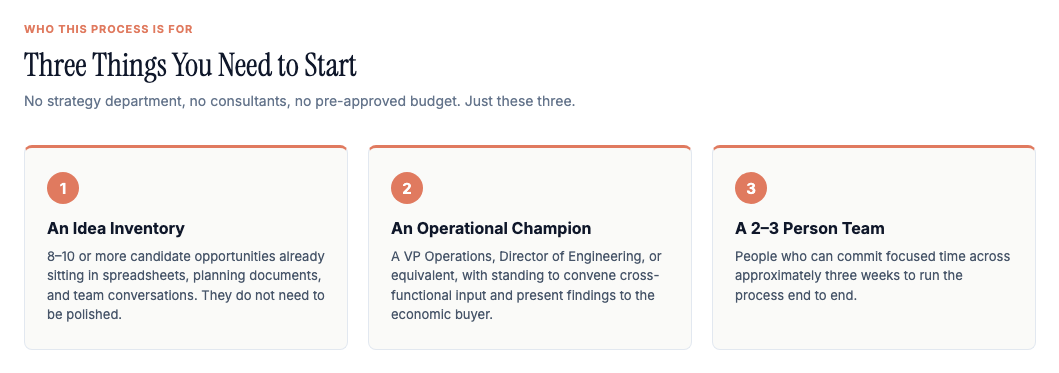
That is it. No strategy department. No dedicated innovation team. No outside consultants. No pre-approved innovation budget. No board sign-off before you begin. Board involvement comes after you have the output.
This process was designed for the majority of mid-market manufacturers who have not yet formalized innovation portfolio scoring.
In our experience, most mid-market manufacturers reach portfolio decisions in one of two ways. Either an informal judgment that tracks seniority more than evidence. Or a costly consultant engagement that produces a report with a similar list. This process is the third option.
If you have the ideas and a champion, you are ready for Step 1.
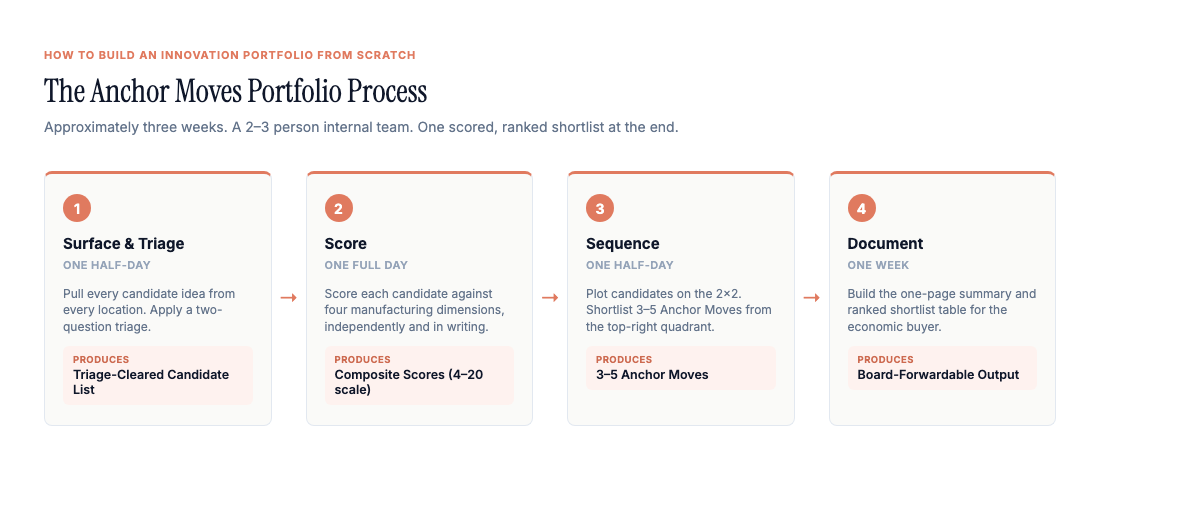
Step 1: Surface and Triage Your Idea Inventory
Step 1 of the Anchor Moves Portfolio Process takes one half-day and requires 2–3 people. The objective is not to generate new ideas. It is to surface what already exists inside the business.
Pull every candidate from every location: planning offsite notes, engineering backlogs, customer conversations, sales wish lists, operational improvement ideas stuck in someone's inbox. The filtering instinct will be strong. Resist it. At this stage, everything goes on the list.
This step is retrieval, not invention. The inventory almost certainly exists already.
Once the list is assembled, apply a two-question triage to each item:
- Is this a real opportunity that the business has any credible basis to pursue, or is it a wish with no internal pathway?
- Does it represent a distinct opportunity type: new product, new channel, process innovation, or changed customer model?
Apply the triage consistently, including to the ideas you personally back. An idea that fails Question 1 stays off the candidate list no matter who is attached to it. The triage criteria are the authority, not seniority.
The output of Step 1 is a triage-cleared candidate list, typically 8–20 opportunities, each with a one-line opportunity statement. Step 2 is the scoring mechanism that ranks this list.
Step 2: Score Each Opportunity Against Four Manufacturing Dimensions
Generic innovation models score impact, feasibility, and fit: a set built for product managers, not plant floors. Mid-market manufacturers operate on engineering months and tooling budgets, and the scoring model has to align with that.
Strategic fit. Does this opportunity reinforce where the company is competitively positioned and intends to go? Research on 207 Australian manufacturing firms found that strategic fit between innovation strategy and business environment is a valid predictor of business performance [Prajogo, 2016]. Score against stated competitive positioning, not aspiration.
Capability reuse. Can the company execute this with capabilities it already has or can build incrementally, or does it require net-new capabilities representing a separate investment thesis? This dimension is absent from generic models because it maps to a manufacturing-specific decision: pull engineering off a line or don't.
Market timing. Are customer signals, OEM requirement changes, or supply chain shifts creating a credible window now rather than in 3–5 years?
Validation cost. What is the minimum the company must spend (in engineering hours, tooling, or market testing) to confirm or disconfirm this opportunity before committing full resources? Validation cost and capability reuse are manufacturing-specific because they map to how mid-market operators allocate engineering months and tooling budgets: the two levers generic models ignore.
Tag the bet type before you score it. Mark each candidate proven-adjacent (extends a capability the plant already runs) or genuine-unknown (tests something the plant hasn't done before). Write the tag next to the composite score, not instead of it. The four dimensions still apply to both. But the tag changes what the score means. A genuine-unknown candidate with a strong composite score gets validated by a cheap, fast test in Step 4. A proven-adjacent candidate with the same score is closer to execution-ready. Two candidates can tie at 16/20 and still carry very different risks: the tag is what tells you which.
Scoring rubric:
| Dimension | Score 1 | Score 3 | Score 5 |
|---|---|---|---|
| Strategic fit | Conflicts with or unrelated to current competitive positioning | Supports adjacent capability; not core direction | Directly reinforces stated positioning and leverages existing operational strengths |
| Capability reuse | Net-new capabilities required; separate investment thesis | Incremental development on an existing platform | Executable with current capabilities or a one-step extension |
| Market timing | No credible signal within 24 months | Emerging signals; timing uncertain | Active OEM requirements or customer demand creates a window now |
| Validation cost | >$150K in engineering or tooling before signal | Dedicated engineering allocation; no new tooling | Proof of concept within existing cycles, under $25K |
Anchor Moves Portfolio Process: worked example. The scoring below is a hypothetical illustration of how the process applies to a single candidate. A 120-employee discrete manufacturer is evaluating whether to add a secondary heat-treat capability to serve an adjacent OEM segment. Here is how the candidate scores using the rubric above:
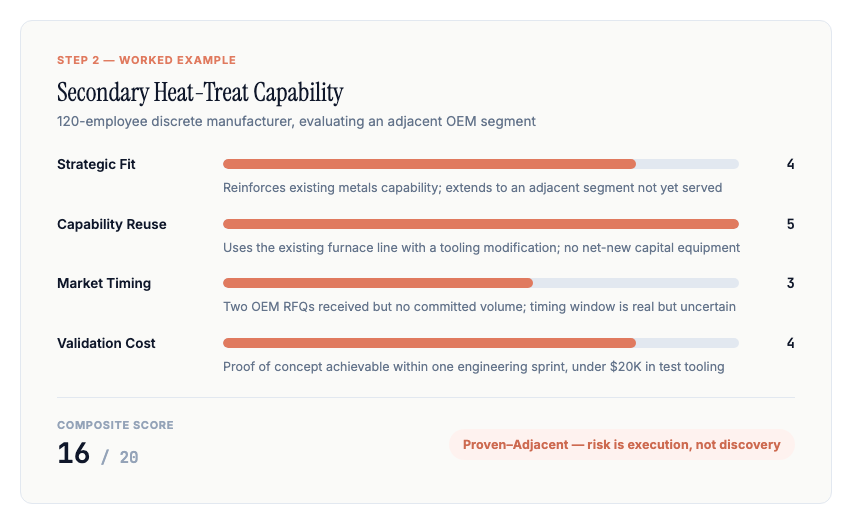
Composite score: 16/20. Bet type: proven-adjacent. The plant already runs the core furnace-line capability; the primary risk is execution, not discovery. On the 2x2 in Step 3, this candidate plots in the top-right quadrant: Anchor Move candidate. A candidate scoring 8/20 (low strategic fit, high validation cost) plots bottom-left and does not advance. This example is illustrative — your candidates will differ, but the scoring logic is identical.
Score each dimension independently, in writing, before any group discussion. This is the structural protection against the loudest-voice problem, not a facilitation preference. Documented scores are the authority when anyone, at any level, disputes the outcome after the session.
The Anchor Moves Portfolio Process assigns each candidate a composite score on a 4–20 scale (4 dimensions × 1–5 per dimension as defined in the rubric above). Those scores are the input to Step 3, where the shortlist becomes Anchor Moves.
Step 3: Sequence Your Shortlist Into Anchor Moves
Each candidate now carries a composite score and an estimated validation cost. Three terms must be distinguished before sequencing (in parallel, not sequentially) because the structural differences matter.
The Anchor Moves Portfolio Process defines an Anchor Move simply: a high-fit, low-cost-to-validate opportunity. The company can pursue it in the next 12–18 months. No restructured capabilities or budget needed. A priority is a relative position on a list: no scoring basis, just rank. A project is an initiative already resourced and scoped. An Anchor Move sits between these: it has cleared the scoring filter but has not been committed. That distinction is what makes it actionable rather than aspirational.
Building the 2x2. Plot each candidate on a matrix. Composite score sits on the vertical axis. Validation cost sits on the horizontal axis, with high cost on the left and low cost on the right. The top-right quadrant (high composite score, low validation cost) is the Anchor Moves zone. Candidates that land here are the shortlist.
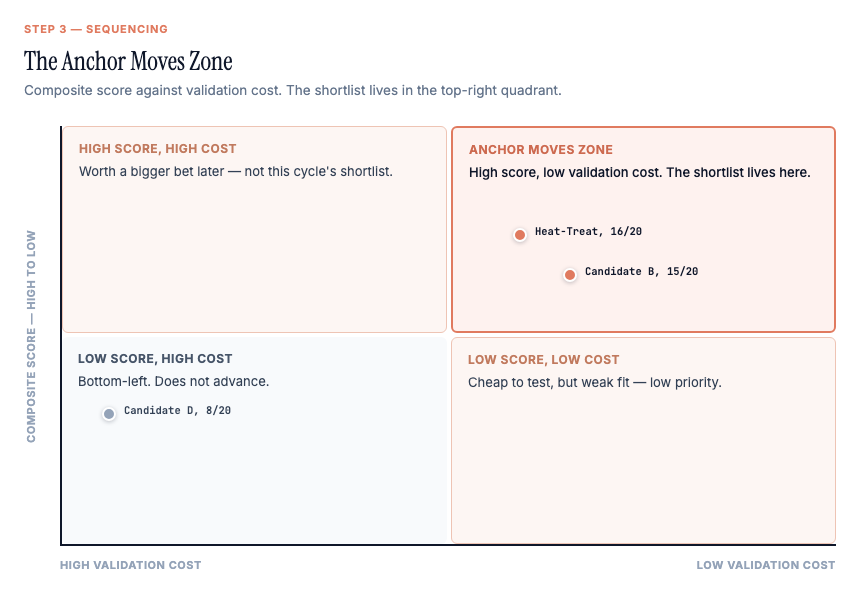
Sequencing within the zone. When two candidates have similar composite scores, the one with the lower validation cost goes first. It returns a signal faster and preserves optionality on the higher-cost opportunity: you learn whether the adjacent thesis is worth pursuing before committing the resources it requires.
Target: 3–5 Anchor Moves. Fewer than three signals too narrow a scope; more than five makes the shortlist indefensible in a budget conversation.
Exit condition. When the team has 3–5 candidates in the top-right quadrant with documented composite scores and validation cost estimates, the shortlist is complete. Stop scoring. Do not expand it to fit in a late favorite, no matter who is championing it. The gate is defined by the matrix, not by committee. Move to Step 4, where the scored shortlist becomes board-ready output.
Step 4: Build the Output That Survives a Leadership Meeting
Step 4 produces two documents.
One-page summary per Anchor Move. All five components required, and any missing means it is not decision-grade: (1) opportunity statement, (2) composite score with dimension breakdown, (3) estimated validation cost, (4) earliest go/no-go decision date, (5) capability or resource requirement for the first validation step.
Ranked shortlist table. All 3–5 Anchor Moves with composite scores side by side: the document the champion forwards to the executive leadership team, not a slide deck.
Board-ready checklist: binary test. For each Anchor Move:
- Composite score with dimension breakdown
- Validation cost estimate
- Go/no-go date
- Owner-dependency noted
Missing any of these four for any Anchor Move means the output is still a list, not a portfolio. The fourth check is the one teams skip: would this move survive its champion stepping away for two weeks? If execution depends on one specific person's hands-on involvement (not just approval, but the work itself), name it. A board that funds a move without knowing this is funding a person, not a plan.
This pre-answers the critical budget questions: Why these? What does validation cost? What do the first 90 days look like?
Most companies eventually build some process for executing decisions already made: that happens naturally, out of operational necessity. What does not happen naturally is scoring and ranking before the decision, which is exactly the discipline this process builds. A board-ready output is not internal hygiene; it is what better-performing operators produce.
"A scored shortlist of three to five Anchor Moves is the difference between a budget conversation and a budget meeting that ends with the same list it started with."
The champion now has output they can forward to the economic buyer without translation. Even a well-designed process can fail in the room; the next section names the failure modes.
Where This Process Breaks Down and How to Prevent It
The majority of mid-market manufacturers in the 50–200-employee range still lack a formal scoring or ranking process for innovation opportunities. That absence is not just a gap in tools: it means the organizational muscle for disciplined scoring does not yet exist. Four failure modes exploit that gap.
Anti-Pattern 1: Conviction Outruns Evidence. The ranked output gets overridden by the strength of someone's belief rather than the strength of the case. The honest version is that any of us does this, most easily when the ranking disagrees with a call we had already made in our heads. The fix is not to trust people less. It is that documenting scores individually, before any discussion, gives the final decision something to stand on that seniority alone cannot provide. When a leader can point to a written, independent score behind every rank, the call stops being "because I said so" and becomes something the board cannot easily unpick. The scores do not constrain the leader. They arm the leader.
Anti-Pattern 2: Performative Exercise. Leadership has already decided on a specific initiative and uses the process as cover. This is the highest-stakes failure mode: it wastes three weeks and inoculates the team against the next real attempt. The go/no-go gate at Step 3 is designed to surface it early: if no candidate reaches the top-right quadrant with honest scores, stop. Name the constraint out loud. Do not continue producing output for a conclusion that was predetermined.
Anti-Pattern 3: Insufficient Idea Inventory. Fewer than five viable candidates after Step 1 triage means the ranking is not meaningful: you are ordering noise. The fix is not more scoring; it is scope expansion before scoring begins. Step 1 surfaces this immediately. If the candidate list falls below the threshold after triage, the process requires a broader input pass rather than acceleration.
Anti-Pattern 4: No Champion with Budget Standing. Without someone who can convene cross-functional input and present findings to the economic buyer, the output has no path to a decision. This is a prerequisite, not a mid-process discovery. If it surfaces mid-process, stop and resolve the sponsorship gap first.
The Loudest-Voice Scenario, Named. Here is the specific scene, and most of us have been on both sides of it. Someone with standing says a score aloud for the initiative they favor before anyone has written theirs down. Everyone else's estimate quietly bends toward it. That is not spinelessness. It is anchoring, and it operates on all of us whether we notice or not. So the written record, if it exists at all, captures the adjusted numbers rather than independent judgment. The fix is not a facilitation technique and it is not about distrusting anyone: document scores individually, in writing, before any number is said aloud. That one rule is what lets a leader fund a decision they can genuinely trust rather than one the room simply agreed to, and defend it later on the strength of the scores rather than the volume in the room.
Independent scoring before group discussion is the single most important decision in this entire sequence. Everything else (the 2x2, the Anchor Moves shortlist, the board-ready output) depends on it being honored. It is also the cheapest safeguard you have: a rule about the order things happen in, costing nothing, that decides whether the output can survive the room where it will be argued.
Key Takeaways
- A list becomes a portfolio when every opportunity is scored, ranked, and defensible.
- Four dimensions: strategic fit, capability reuse, market timing, and validation cost.
- Anchor Move (Anchor Moves Portfolio Process): a high-fit, low-validation-cost opportunity pursuable in 12–18 months without restructuring capabilities or budget.
- 2–3 people, approximately three weeks.
- Board-forwardable output: one-page summary per Anchor Move plus ranked shortlist table.
- Independent scoring before group discussion is the single structural protection against politics overriding scores.
What a Decision-Grade Portfolio Looks Like and What to Do Monday
Three weeks. A 2–3 person internal team. No consultants, no strategy department, no innovation function. Here is the exact timeline:
| Milestone | Time |
|---|---|
| Step 1 — Triage | One half-day |
| Step 2 — Scoring | One full day |
| Step 3 — Sequencing | One half-day |
| Step 4 — Documentation | One week |
| Review session with economic buyer | One session |
Total: approximately three weeks.
The output: a ranked shortlist of 3–5 Anchor Moves the champion can put in front of the economic buyer, defend in an executive leadership team conversation, and use to request a specific innovation budget line, with documented scores behind every claim. A one-page summary per Anchor Move. No translation required.
Cooper's research on new-product portfolio management ties this discipline directly to performance: companies that take portfolio management seriously outperform the ones that don't [Cooper, Edgett & Kleinschmidt, 1999]. The champion who completes this process is doing what higher-performing companies already do differently. In competitive terms, that is a structural differentiator, not a process upgrade.
Here is what changes when the portfolio exists:
① Annual planning stops starting from a blank whiteboard. It starts from a ranked, scored baseline.
② Last year's shortlist, with documented reasoning, is already there.
③ Every subsequent planning cycle is faster and more defensible than the one before: that is the durable value of a scored baseline over a whiteboard.
If you want to move faster than running Steps 2 and 3 by hand, Hephanos runs a structured market and competitive research process, scored against your stated competitive strategy, and returns a scored, ranked Top 5 Anchor Moves candidate list from a short intake within hours. It does not replicate your team's plant-specific read on capability reuse or validation cost: that judgment still needs your review before the shortlist goes to the economic buyer. Triage, documentation, and coordination remain yours.
The champion who runs this process stops starting over every year.
Sources
- Cooper, R.G. & Edgett, S.J. (2012). "Best practices in the idea-to-launch process and its governance: A study of new-product development practices at 211 businesses." Research-Technology Management, 55(2), 43–54. https://doi.org/10.5437/08956308X5502022
- Prajogo, D. (2016). "The strategic fit between innovation strategies and business environment in delivering business performance." International Journal of Production Economics, 171(Part 2), 241–249. https://doi.org/10.1016/j.ijpe.2015.07.037
- Cooper, R.G., Edgett, S.J. & Kleinschmidt, E.J. (1999). "New product portfolio management: Practices and performance." Journal of Product Innovation Management, 16(4), 333–350. https://doi.org/10.1016/S0737-6782(99)00005-3